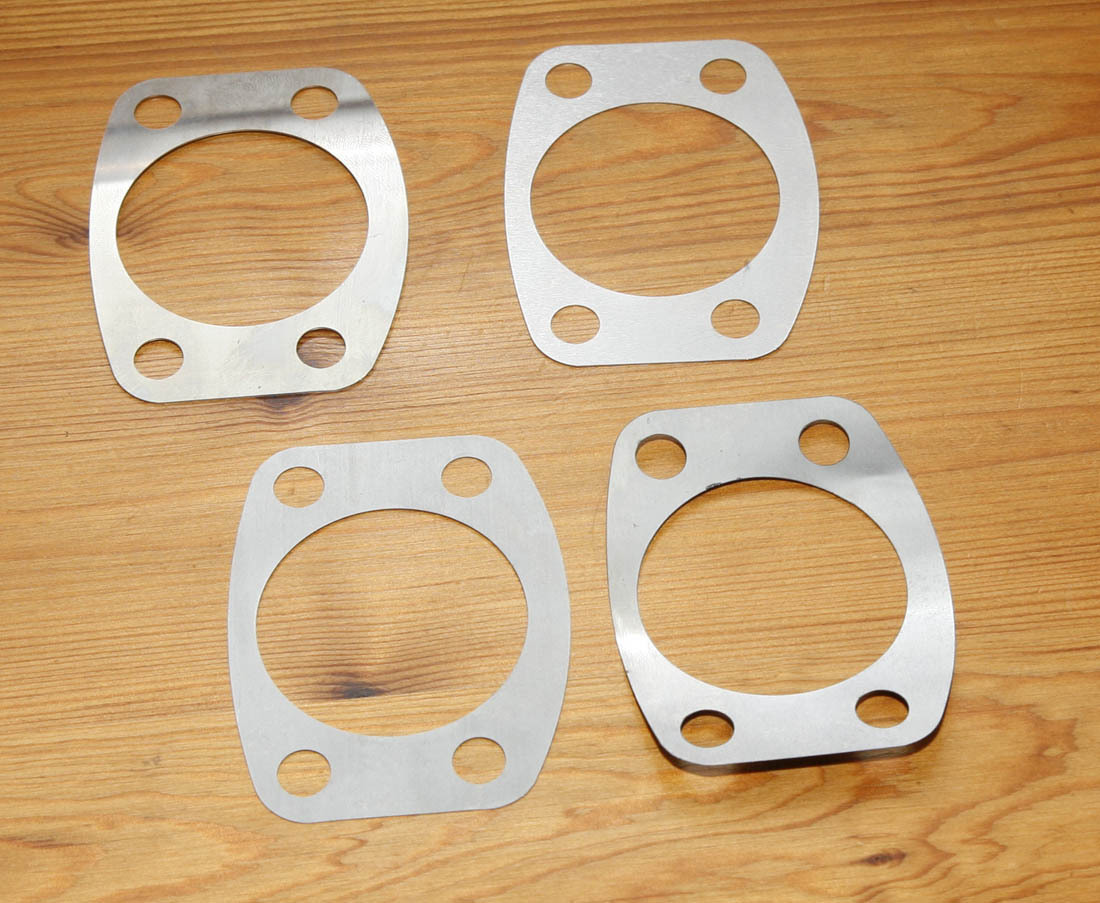
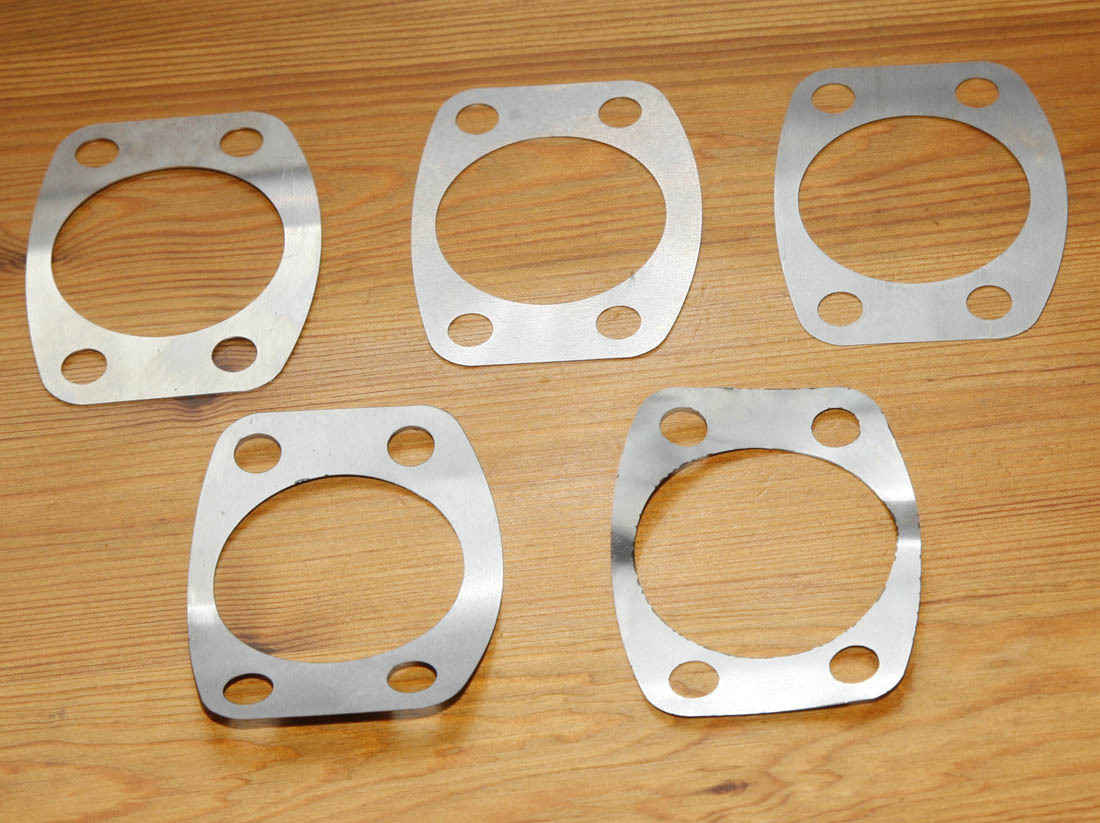
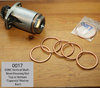
Essential when rebuilding your SOHC (or Longstroke DOHC) engine to ensure that the lower vertical bevel gear has the correct backlash and position in relation to the crankshaft bevel gear, these lower bevel shims fit between the crankcase bevel case housing and the lower vertical bevel housing. Available in various thicknesses - either one or multiple shims are fitted behind the mainshaft beve gear to ensure the correct mesho of lower bevel gears.
Price is per single Shim . Specify which size (or sizes) you require when placing order, in comments section.
Back In stock October 2025 - but please note: There has been a huge price increase (post covid) since we last had these manufactured in 2021. I am sorry this is the case - but the process of having these special extra big shims manufactured is far more difficult than you may imagine and our shim manufacturer, as well as having had substantial uplift in cost, has also taken into account the difficult setup prcoess to have these made. Therefore, apologies these are not cheap - but hope you will appreciate why, and that at least they are now available again (and actually - having spent much time trying to find alternative quotes - on the small volumes we have made - those quotes were far higher than the price shown here!). Final point - part of that manufacturing process it to make a post check on each shim and ensure cutting burrs are removed - this may result in some shims having slight linishing marks - but this will not affect the overall thickness of the shim.
Shims are available in the following thickness:
- 0.1mm = 0.004" or 4 thou
- 0.2mm = 0.008" or 8 thou
- 0.3mm = 0,012" or 12 thou
- 0.5mm = 0.021" or 21 thou
It is common practice to measure float with no shims fitted, then add one or multiple shims to reach the desired final endfloat, measuring each time shims are added or subtracted.
It is recommended to have a selection of shims are available (for each bevel gear type) before you start the shimming operation, as accurate measuring of the bevel gears positioning (in relation to each other) and backlash can normally only be achieved by adding or subtracting shims. By adding or removing shims of different thickness, eventually the correctly shimmed position of each gear (in relation to the other gear) will be achieved. Any unused shims can then be saved in a tin (or sealable bags, marked with the relevent thickness of each type) for any future builds or checking.
FYI - I keep a selection of shims - for each bevel gear type, and all thicknesses, out in the workshop - I can then re-use this tin of shims (i.e. the ones I dident fit on the last build) for the next time I am shimming an engine.
Before starting the bevel shimming process, it is important to have first shimmed the crankshaft inside the crankcases - the purpose of this is premarily to ensure the conrod is cenralised to the barrel/piston centreline. The crankshaft on SOHC engines is effectively 'locked' to the timing side bearing - again by using shims (our item 0263 for International/CS1 engines or 026 for 30M/40M/Manx engines), and then any excess end float of the driveside roller bearing inner race is taken up using driveside shim (our item 0262). Once the crankcases and crank are then assembled, with correct shimming for crank done - the lower bevel gear shimming can be done.
These shims are specially made for us, to fit on the lower bevel housing of of SOHC engines (and DOHC LS Manx engines up to the mid 1950s, and they fit over the studs on the bevel case platform. Because the shimming process can mean having to remove or add various shims multiple times to get the final fit correct - it can be a time consuming process . . and can take multiple attempts. Dont worry - it is perfectly normal to get frustrated with this process - but getting it right is worth the effort!
Note - at some time in the mid 1950's, the DOHC Manx Norton engine was revised (note: this was for the DOHC Featherbed Manx engine only - the roadgoing aluminium SOHC International engine retained the shim type shown her for all its opearational life), and the outer diameter of the large hole on those shims was enlarged slightly. We can also offer those larger hole DOHC (coarse bevel) shim type as well - See Item 0862 for that shim type and you can email us if you require more information on these.
Shimming a SOHC Engine: Background Information and Helpful Hints:
Shimming of the bevel gears on SOHC camshaft Norton engines is possibly one of the most important tasks to be carried out when building a SOHC engine (i.e. 1930 - late 1950's Internationals, CS1's and SOHC and up to mid 50's DOHC Manx Norton models) - to ensure both lower and upper vertical bevel gears are shimmed correctly in relation to each other and give reliable operation in serivce.
Ideally, the two pairs of gears - which are in a 90 degree plain to each other - to transfer rotation from horizontal (crankshaft) to vertical to horizontal again (camshaft) - should have the teeth in full contact with each other (i.e. teeth not overhanging in one direction or the other) and have just an imperceptable level of backlash.
By backlash - we mean that there is a fractional gap between the mesh of each tooth - and at its extreme this can be seen when rotating the crankshaft, there is a fractional delay until you see the vertical shaft move.
Shimming should always be done with a cold engine - and the generally regarded optimum setting for the gear backlash is that there should be just a trace of backlash - but barely perceptable!
Of course - by far the most important thing to avoid is 'negative backlash' - i.e. when the bevel gears are fully tightened up in assembly - there is no backlash at all, and in fact the teeth are pushing against each other - this puts a huge amount of strain on the teeth and can lead to excess wear and premature failure.
Therefore 3 very helpful hints when first shimming each pair of gears (lower and upper):
1 - I always carry out the bevel shimming process with perfectly clean and spotless gears (obviously!) - but they are also 'dry' for this operation, i.e. I do not put oil on them until the shimming process is complete. By shimming them with dry gears I can far more easily hear the faint 'clicking' of the gears against each other, which indicates there is some backlash. If with no oil you can not hear any 'clicking' - you are either very close to no backlash, or have none. It is very difficult to describe - but I tend to look for something I call 'almost imperctable backlash'!, i.e. just the very faintest level of backlash, that you may not even hear - but having carefully measured and watched, you know there is just the faintest backlash. Certainly - if with dry gears you can hear a distinct clicking and see a delay in movement of one gear to the other - that would indicate possibly to much backlash. Once shimming is completed, for final assembly - all components should be liberally coated in oil and a final check made that all still looks well
2 - I find it is better for the start of the process of shimming to have less shims fitted more. By doing this (hopefully!) you will start with a very visible 'excess' of backlash, and then by addiing a given thickness of shim, you can then visually see how much of that backlash disappears. This can help you to gauge the thickness of further shims you may need to add or remove. After a while you find you can become quite good at guessing the thickness that needs addiing or removing
3 - It is very important once you have found the correct shimming settings for each set of bevel gears (i.e. lower and upper) - to ensure you fully rotate the engine a number of times - and ensure that in all positions you have a minimum level of backlash (i.e 'imperceptable backlash) at the tightest spot. Ideally it should not make any difference in any position - but the reality is, it is not unusual to find that at one point in the full circular rotation of the engine - there is a spot where the gears are fractionally closer together than at other points - it is important that the correct shimming is achieved at this point (with no negative backlash).
And finally of course - dont worry if this process takes a long time and seems frustrating - we all suffer with the same anxities when carrying out this task, and sometimes patience and a glass of red wine are required!